
Current service information
Polarising microscopes
The KERN OPO-185 polarizing microscope is a precision instrument for crystallographic analysis, material testing and petrography. With its advanced features and brilliant optics, it’s the ideal choice for research, education and industry – whenever polarized light matters.
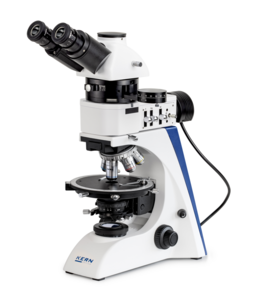
Polarizing microscopes for petrography and material analysis – the KERN OPO-185
Reveal crystal structures – with polarized light from KERN.
The KERN OPO-185 polarizing microscope delivers highest precision for demanding applications in mineralogy, petrography, crystallographic analysis and material science. Equipped with a professional rotating stage, an adjustable analyzer, an integrated Bertrand lens system and high-quality infinity-corrected optics, this microscope ensures brilliant imaging results when examining anisotropic materials.
Thanks to its well-thought-out design, transmitted and reflected light illumination, and modular configuration, the KERN OPO-185 is perfectly suited for both professional laboratory use and academic training. Its robust mechanics and precise focusing system make it ideal for analyzing thin sections, crystalline samples, or fibrous materials under polarized light.
Typical fields of application:
✔ Petrography – analysis of rock thin sections
✔ Mineralogy – identification of mineral structures
✔ Materials science – e.g. plastics testing or geotechnical analysis
✔ Crystallography – for research and academic use
✔ Polarized light microscopy – in laboratories, universities, and industry
Target groups:
✔ Geoscientists and petrographers
✔ Material testing laboratories and quality control departments
✔ Universities, schools, and training centers
✔ Research institutes focused on materials and crystals
Why choose a polarizing microscope from KERN?
With more than 180 years of expertise in precision technology, KERN & SOHN GmbH stands for reliability, engineering excellence, and durable instruments. The OPO-185 polarizing microscope impresses with its modular construction, intuitive operation and high-grade optics – engineered for professional use.
? Frequently asked questions about polarizing microscopes
1. What is a polarizing microscope?
A polarizing microscope is a specialized type of light microscope that uses polarized light to examine anisotropic materials. This makes it possible to detect crystal structures, birefringence, internal stresses, and other properties that remain invisible under conventional illumination.
2. What is a polarizing microscope used for?
Polarizing microscopes are primarily used in the following fields:
3. What is the difference between a standard light microscope and a polarizing microscope?
A polarizing microscope includes additional components such as a polarizer, analyzer, often a Bertrand lens, and a rotatable stage. These features enable the detailed observation of birefringent materials, which cannot be properly analyzed with a standard light microscope.
4. Who is the KERN OPO-185 suitable for?
The KERN OPO-185 is especially recommended for:
5. What can be observed using polarized light microscopy?
Polarized light microscopy makes visible, for example:
6. Can I connect a camera?
Yes, the KERN OPO-185 is equipped with a trinocular head, allowing the integration of a microscope camera – ideal for live imaging, documentation or teaching.
Discover the hidden structure of materials – with the KERN OPO-185 polarizing microscope.
Our specialists will be happy to advise you:
Phone: +49 (0)7433 / 9933-777
Email: optics@kern-sohn.com
Reveal crystal structures – with polarized light from KERN.
The KERN OPO-185 polarizing microscope delivers highest precision for demanding applications in mineralogy, petrography, crystallographic analysis and material science. Equipped with a professional rotating stage, an adjustable analyzer, an integrated Bertrand lens system and high-quality infinity-corrected optics, this microscope ensures brilliant imaging results when examining anisotropic materials.
Thanks to its well-thought-out design, transmitted and reflected light illumination, and modular configuration, the KERN OPO-185 is perfectly suited for both professional laboratory use and academic training. Its robust mechanics and precise focusing system make it ideal for analyzing thin sections, crystalline samples, or fibrous materials under polarized light.
Typical fields of application:
✔ Petrography – analysis of rock thin sections
✔ Mineralogy – identification of mineral structures
✔ Materials science – e.g. plastics testing or geotechnical analysis
✔ Crystallography – for research and academic use
✔ Polarized light microscopy – in laboratories, universities, and industry
Target groups:
✔ Geoscientists and petrographers
✔ Material testing laboratories and quality control departments
✔ Universities, schools, and training centers
✔ Research institutes focused on materials and crystals
Why choose a polarizing microscope from KERN?
With more than 180 years of expertise in precision technology, KERN & SOHN GmbH stands for reliability, engineering excellence, and durable instruments. The OPO-185 polarizing microscope impresses with its modular construction, intuitive operation and high-grade optics – engineered for professional use.
? Frequently asked questions about polarizing microscopes
1. What is a polarizing microscope?
A polarizing microscope is a specialized type of light microscope that uses polarized light to examine anisotropic materials. This makes it possible to detect crystal structures, birefringence, internal stresses, and other properties that remain invisible under conventional illumination.
2. What is a polarizing microscope used for?
Polarizing microscopes are primarily used in the following fields:
- Petrography: examination of thin sections of rocks
- Mineralogy: identification and classification of minerals
- Crystallography: detection of twinning, cleavage planes, etc.
- Materials analysis: inspection of plastics, fibers, or composites
- Forensics and education: e.g. stress analysis in transparent materials
3. What is the difference between a standard light microscope and a polarizing microscope?
A polarizing microscope includes additional components such as a polarizer, analyzer, often a Bertrand lens, and a rotatable stage. These features enable the detailed observation of birefringent materials, which cannot be properly analyzed with a standard light microscope.
4. Who is the KERN OPO-185 suitable for?
The KERN OPO-185 is especially recommended for:
- Geoscientists (petrography, mineralogy)
- Materials testers in industry and laboratories
- Educators and students in scientific disciplines
- Researchers in crystallography and materials science
5. What can be observed using polarized light microscopy?
Polarized light microscopy makes visible, for example:
- Crystal orientation and structure
- Stress patterns in plastics or glass
- Mineral phases and rock textures
- Optical effects such as interference colors and birefringence
6. Can I connect a camera?
Yes, the KERN OPO-185 is equipped with a trinocular head, allowing the integration of a microscope camera – ideal for live imaging, documentation or teaching.
Discover the hidden structure of materials – with the KERN OPO-185 polarizing microscope.
Our specialists will be happy to advise you:
Phone: +49 (0)7433 / 9933-777
Email: optics@kern-sohn.com